
Joint legislators: the European Parliament and the Council of the EU
While the Commission can propose legislation, it is the European Parliament and the Council of the EU (also known as the Council of Ministers) that jointly adopt new legislation.
The procedure for adopting EU legislation can take place in 3 different ways, through the ordinary legislative procedure, the consultation procedure or the approval procedure. The most important and most used way of making decisions in the EU is through the ordinary legislative procedure, which is based on both the European Parliament and the Council of Ministers having to approve the bill before it can be adopted. Previously, the directly elected European Parliament simply had to be consulted on new laws, but they have gradually gained the status of co-legislators. It is thus the European Parliament and the Council of Ministers that make decisions regarding the adoption of EU legislation, while it is the European Commission that can put forward legislative proposals. The European Parliament and the Council of Ministers can call on the Commission to propose legislation, but ultimately they cannot adopt EU laws without a proposal from the European Commission.
European Parliament
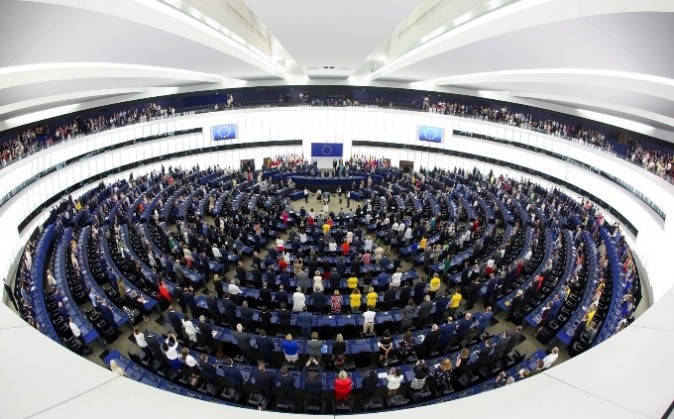
The European Parliament (or simply 'Parliament') consists of 705 members (MEPs) elected by the electorate of the member states. It is thus elected politicians who sit in Parliament with the aim of representing the voters' interests in accordance with EU legislation and to ensure democratic decision-making processes in EU institutions and in Europe in general. The Parliament is the only body in the EU that is directly elected by the voters. Parliament's work is wide-ranging and, in addition to the adoption of EU legislation, also deals with decisions regarding the EU budget, control of institutions and cooperation with national parliaments.
Parliament, in cooperation with the Council of Ministers, makes decisions on the EU's annual budget. In this process, the Parliament is responsible for ensuring that the EU funds are used properly and it is ultimately the Parliament that has the final approval. In addition, it is Parliament's responsibility to supervise other institutions, including The European Commission, the European Council and the Council of Ministers.
Parliament has a large number of committees (committees) for the various policy areas where legislative proposals etc. is discussed, and where you make recommendations to your political group regarding positions on new legislative proposals, statements, etc. In the environmental area, the committee is called ENVI (Committee for Environment, Health and Food Safety). It is also in ENVI that climate issues are dealt with, as climate does not yet have its own committee.
The Council of Ministers: The member states' 'control mechanism'
The EU is an institution with both intergovernmental and supranational features. In certain areas, e.g. decisions are taken, with a qualified majority in the Council of Ministers, on laws that have direct effect in the Member States. This can also partially be done in the environmental area
The climate and environment areas are examples of the existence of different possibilities and conditions for legislation in the EU, depending on the policy area. Climate issues are dealt with predominantly in the European Council, which consists of the heads of state and government, the permanent president of the Council, and the president of the Commission. Climate policy is an area where unanimity is required among the member states in order to adopt new measures – for example in relation to binding targets for CO2 emissions.
The environment has been part of EU policy for a long time, and was registered as official EU policy with the Maastricht Treaty (1993). This made it possible to make decisions with a qualified majority in the Council of Ministers in the area, and to make laws (directives and regulations) with binding effect in the member states. In 1997 (the Treaty of Amsterdam), it was added that environmental protection must be considered in all policy areas in the EU.
The European Council: The strategic guide
The European Council (DER) consists of the heads of state and government, the permanent president and the Commission president. DER meets twice every six months, and the meetings are also called EU summits. This is where the general guidelines for the EU's work and priorities in the coming years are discussed. The EU's climate policy, recovery plan, etc., are examples of things that are discussed at the meetings. THERE is thus also a place where the Member States help set the direction for the Commission's work, and the areas that the Member States want the Commission to focus on.
Read more about the EU institutions: https://www.eu.dk/da/fakta-og-tal/institutioner