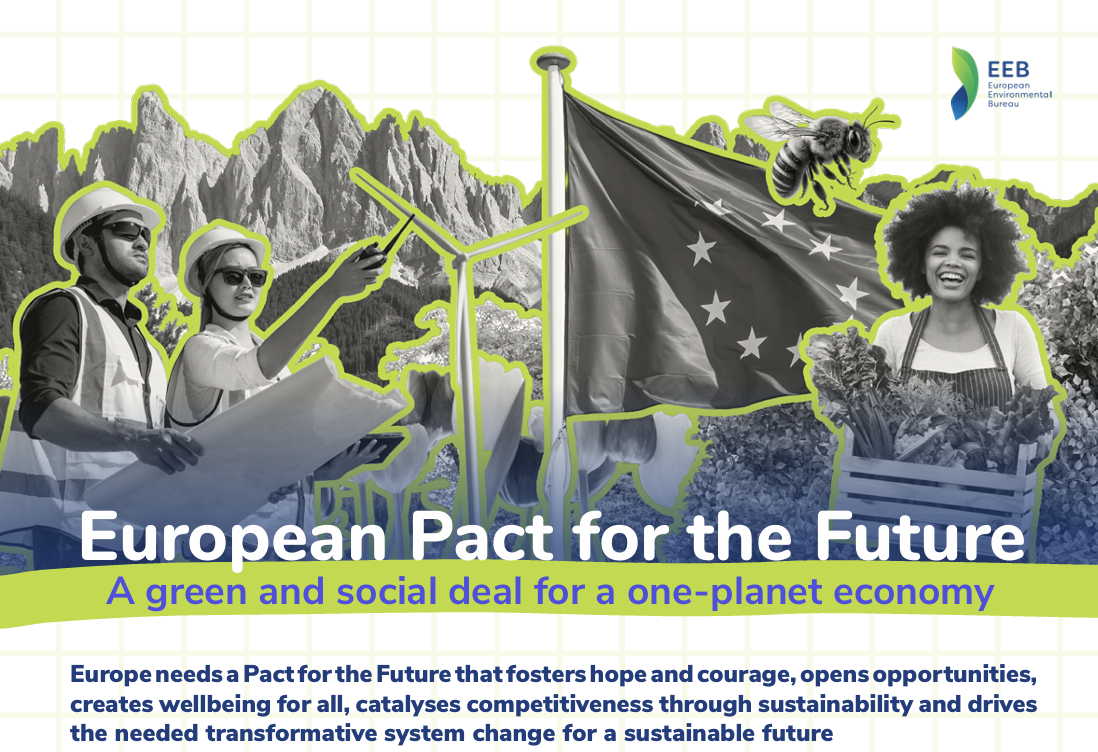
Sign the new green pact for Europe's future - a green and social pact for the economy within the planetary boundaries

That is the main message in one new covenant, which the Green Transition Denmark has signed along with a number of European environmental organisations. The pact, drawn up under the leadership of the European Environmental Bureau in Brussels. At the same time, it is a clear call to vote green in the European Parliament elections this June.

It is important that many citizens, organizations and green front-runner companies sign the pact, which has 12 proposals for how we can solve the linked climate, biodiversity and pollution crises, which cause concern from the future. The pact recommends that the EU sets a new course in the next five years: a deep ecological restructuring of the economy away from dependence on fossil fuels and towards clean renewable energy, circular economy and organic food production.

A green alternative to the industry's Antwerp Declaration
The green future pact will be handed over to the next EU summit in mid-June, when the heads of state and government meet. The Green Pact is also a clear alternative to it Antwerp Declaration, which Europe's industry launched in the spring at the chemical group BASF's factory in Antwerp. Business Europe, a number of the major European industrial companies, including from the oil, gas and chemical industries, but also some trade unions and industry associations have signed the Antwerp declaration, which wants the EU to create a new industrial pact, which will easier to run a business, simplify the rules on the internal market, and strengthen the EU's raw material security. There are thus significant differences between the green organizations' future pact and the industry's Antwerp declaration.

Sign the green future pact
Green Transition Denmark would like the EU to pursue a more aggressive industrial policy in the next five years, which can also speed up the green transition. But it must be done with binding requirements. It is important that binding environmental requirements are set and high green objectives are set, so that Europe's companies do not compete down to a lower common denominator, or that the environmental requirements in the EU's internal market are relaxed. That is why we at the Green Transition Denmark strongly recommend everyone to sign the new green future pact.

You can read the entire covenant here.. Sign if you support the green future pact so that before the EU's next summit we can collect more signatures than those who support the Antwerp declaration.

By |2024-06-03T07:59:36+01:0029 May 2024|News|Comments closed to Sign the new green pact for Europe's future – a green and social pact for economy within the planetary boundaries

Open letter: Revise the North Sea Agreement for a fair, fossil-free future

The government should bring forward the end date for fossil production to 2031 and close the continued options for fossil expansion that the current agreement allows through so-called 'mini-rounds' and 'neighbouring blocks'. This is what it says in a joint appeal to the government, in which RGO, together with 16 NGOs and almost 100 researchers, are involved.

The letter has been sent to Climate, Energy and Supply Minister Lars Aagaard (M), Minister for Development Cooperation and Global Climate Policy Dan Jørgensen (S), Environment Minister Magnus Heunicke (S) and Business Minister Morten Bødskov (S).

Read the letter here:

By |2024-05-28T09:59:18+01:0028 May 2024|News|Comments closed to Open letter: Revise the North Sea Agreement for a fair, fossil-free future

Eight organizations call on the climate minister to ensure that the gas boilers are phased out

Green Transition Denmark together with CONCITO, Danish District Heating, Green Power Denmark, Intelligent Energy, SYNERGI, TEKNIQ Employers and the Heat Pump Industry have sent a letter to the Minister of Climate, Energy and Supply, Lars Aagaard.

The letter is sent in light of the Climate Status and Projection 2024, which shows that in 2035 there will still be 110.000 households that are heated with gas boilers. It is problematic because there is a political ambition that from 2035 there should be no homes in Denmark that are heated by gas boilers.

There are many good arguments for phasing out the gas boilers as soon as possible.
We know the alternatives in the form of district heating and heat pumps, and they are both greener and better for society. It will also be expensive as a remaining gas customer to have to maintain a gas network with very few connections.

But there is a lack of a clear signal that gas does not belong in heating. Therefore, a political end date should be set for when gas may no longer be used for space heating, at the same time that initiatives are initiated so that no new gas boilers are installed that can have a lifespan of twenty years.
These initiatives must offer a helping hand to vulnerable households who can get help to convert to district heating or a heat pump.
This is agreed upon by a broad coalition of organizations working with the transformation of the heat supply.

The letter has been sent to the climate minister on behalf of the Green Transition Denmark, CONCITO, Dansk Fjernvarme, Green Power Denmark, Intelligent Energy, SYNERGI, TEKNIQ Employers and the Heat Pump Industry on 3 May 2024.

Read the letter to the climate minister here

By |2024-05-03T14:07:29+01:003 May 2024|News|Comments closed to Eight organisations, the climate minister is calling on to ensure that the gas boilers are phased out

New manifesto: Save resources in the EU

The climate and the planet cannot support a continuously increasing demand for energy, resources and materials. Therefore, resource savings must be focused on the economic and political agenda in the EU

In the future, we must stay within the planetary limits, and this also requires that the EU in the next election period brings resource savings into the heart of the economic and political agenda. The climate and the planet cannot support a continuously increasing demand for energy, resources and materials. Therefore, the Green Transition Denmark together with 74 other European organizations have written a manifesto in which we call on the EU's decision-makers to make sufficiency - that is, sufficiency - a central strategic effort in the coming years. The manifesto is called: A resilient and resource-wise Europe. Sufficiency at the heart of the EU's future.

It is possible to make the entire EU climate neutral and phase out all fossil fuels by 2040, to make the continent self-sufficient with clean renewable energy and to significantly reduce energy and resource consumption in all sectors of the economy. In the manifesto, we recommend i.a. binding targets for reduction in energy and material consumption.

Resource wisdom is cheaper than wisdom

The good news is that it is also actually cheaper than a business-as-usual scenario. Households and companies can save a lot of money on current consumption. The economy's environmental, climate and health costs can be significantly reduced. And if sufficiency is thought from the start and the way we design, consume and produce is rethought, we will also be able to lower the ongoing costs for new investments.

There will of course be many who find it difficult to imagine something that deviates from business-as-usual and the old-fashioned mainstream economy, but in the Green Transition Denmark we see a huge potential for rethinking the way we organize the economy in Europe. New incentive structures are needed that value nature instead of treating it as cheap dirt that is not properly taken into account in the economic models.

By |2024-04-15T13:28:26+01:003. April 2024|News|Comments closed to New manifesto: Save resources in the EU

Climate tax for agriculture: Green Transition Denmark praises expert committee

It is important that Danish agriculture contributes to the fight to reduce Denmark's emissions of greenhouse gases if we are to live up to the national and international agreements, we have entered into. Agriculture covers more than 60 per cent. of our land area, which makes Denmark Europe's most intensively cultivated country, and the agricultural sector accounts for more than 25 per cent. of the Danish greenhouse gas emissions.

The government's expert committee has just proposed three possible models for a tax for agriculture, and the Green Transition Denmark has the following comments on the committee's recommendations:

Quotes, Niklas Sjøbeck Jørgensen, senior advisor for Food and bioresources:

"Danish agriculture must climb out of the hole that the industry has dug deeper into for a long time with the investment in intensive animal production. It is therefore gratifying that the Svarer committee is presenting a proposal for a model with a tax of DKK 750/tonne CO2, which actually leads to the changes and new opportunities that are needed. If we combine the model wisely with the EU's agricultural support and an acceleration of the plant-based sector, we can see a Danish agriculture that operates within the planetary boundaries."

"The expert committee has done a great job and we are particularly proud of the fact that they have gone beyond the 2030 targets and looked at how we can best create a model that lasts all the way to 2045, when we must be climate neutral."

"It is extremely important that we focus on creating a tax architecture that future-proofs agriculture beyond 2030. Fortunately, the committee has had a great deal of focus on that. We must be climate neutral by 2045 – and at the same time we have major challenges with a dead marine environment and a pressured biodiversity. Therefore, the tax of DKK 750/tonne CO2 is clearly the best way forward, as here we are setting a new and more future-proof course for agriculture."


Quotes, Trine Langhede, advisor for Food and bioresources:

"It is important that we do not gamble with investments in technological solutions in order to continue undeterred as we are today. If cows have to have feed additives, it locks them into the barns, instead of letting them out to pasture, where they can benefit biodiversity and the ecosystem in the field.”

“We have not yet seen a single full-scale pyrolysis plant in operation. Therefore, it is extremely uncertain how much effect the technology can actually deliver. We also still lack answers to many important questions about pyrolysis and biochar. For example, we do not know what long-term consequences bringing biochar onto the fields can have on soil and biodiversity. Or whether toxic substances can be formed in the pyrolysis process. Therefore, we hope that the politicians do not create a pyrolysis pool one billion kroner. That money is better spent elsewhere."

Green Transition Denmark has recently presented our own proposal for what a climate tax for agriculture should look like:

By |2024-02-21T13:12:47+01:0021. February 2024|News|Comments closed for Climate tax for agriculture: Green Transition Denmark praises expert committee

Green joy over agreement on passenger tax on flights

A new agreement between the government and SF means that from 2025 you will have to pay an air tax when you fly from Denmark. The money that comes in from the tax must be used partly for the elderly check and partly for the green transition of, among other things, Danish domestic flights. Jeppe Juul from the Green Transition Denmark welcomes this.

"It is really gratifying and a victory that the tax is now finally in place and that around half of the amount is reinvested in the green transition of, among other things, domestic aviation," says Jeppe Juul, senior adviser at the Green Transition Denmark.

He emphasizes that he would have liked to see that the taxes were higher and that all the funds had been used for the green conversion of aviation.

"We are far behind the green conversion of aviation and therefore we are very happy that we are now getting started in Denmark. Taxes don't do it alone, but they can help finance climate action within aviation in the form of new green fuels and fewer contrails," says Jeppe Juul.

The agreement means that from 2025 onwards, Denmark can choose to regulate the purity of aviation fuels in order to limit contrails, which in themselves have a large climate impact that is as great as CO2 from aircraft.

"It is fantastic that there is now an opportunity for Denmark, as the first country in the world, to start addressing the indirect climate impact from contrails from aircraft. It is a big but largely overlooked problem, which Denmark now has the opportunity to take the lead in solving," says Jeppe Juul.

At the same time, he emphasizes the importance of domestic aviation converting to eFuels instead of using biofuels made from residual products, as there is limited availability.

"We need to quickly produce eFuels for aircraft if we are to be able to transform the sector in time both in Denmark and globally. Here, Denmark can play a decisive role by developing and making the necessary technologies cheaper," concludes Jeppe Juul.

Green Transition Denmark has for many years worked for air taxes in Denmark and the EU.

By |2024-01-09T16:05:16+01:0015. December 2023|News|0 Comments

Expert panel states: Agriculture's emission of nitrogen must be significantly reduced

The Danish fjords and the sea along the coasts have this year suffered the greatest loss of oxygen in 20 years and only 5 out of 109 fjords and coastal water areas are expected to achieve good ecological status in 2027, which Denmark is otherwise obliged to ensure according to the EU's Water Framework Directive. According to the Danish marine models, it is calculated that we must reduce nitrogen emissions – the vast majority of which comes from agriculture – by approximately one third. As part of the agricultural agreement from 2021, it was decided that an international research team should re-evaluate the models in the hope that the reduction need was not so great. Now the final report is out.

The report concludes that the Danish models should not be changed significantly and are otherwise exemplary globally. At the same time, it worries the research team behind the fact that there has been no decrease in nitrogen emissions for more than 10 years, while they point out a lack of political initiatives. Therefore, the research team behind also emphasizes that significant and well-documented efforts must be made as soon as possible, so that the marine environment can be improved and EU legislation can be complied with.

"It is gratifying that it has now been established that Denmark's models for calculating nutrient discharge are exemplary and some of the best in the world. Unfortunately, precious time has been lost at the expense of the marine environment because of Second Opinion. Now we can once and for all stop the time-consuming discussion of how much we need to reduce agricultural nitrogen emissions and act instead," says Niklas Sjøbeck Jørgensen, senior advisor at the Green Transition Denmark and continues:

"Danish agriculture must deliver an enormous effort. The current voluntary agreements move far too slowly and never get us to the finish line. We should therefore supplement these agreements by stopping agricultural operations in zones along streams, lakes and the coast, convert more areas into forest and at the same time establish by law that in 2027 no more nitrogen can be emitted than what our models tell us. "

Green Transition Denmark calls for the government to start work as soon as possible with a new nitrogen effort that comes all the way around, and which recognizes that the voluntary agreements are far from enough.

The sooner the politicians agree on a better regulation, the sooner farmers and landowners can also adjust to it - and the sooner we can start the local collaborations between farmers, municipalities and waste water plants.

By |2023-10-27T14:44:44+01:0027. October 2023|News|0 Comments

6 projects share the DKK 1,25 billion. tendered for the start-up of Danish hydrogen production  

It is good news for the climate if the hydrogen is included as a building block in green fuels for aircraft, ship transport or fertiliser, not so good news if the hydrogen ends up in trucks or for heating German living rooms. However, we must wait anxiously to see what the hydrogen from the 280 MW electrolysis capacity will be used for.

In the Green Transition Denmark, we closely follow the development of the Danish hydrogen industry. On the one hand, hydrogen is absolutely necessary for specific sectors that otherwise do not have the opportunity to adapt. On the other hand, the many support kroner can mean that hydrogen is used in places where it is not appropriate in terms of energy and social economy. At the same time, it is crucial that the hydrogen production itself is planned sensibly with flexibility in mind, so that the plants can help balance the electricity grid, as well as release excess heat to the district heating grid.

By |2024-01-16T12:14:03+01:0027. October 2023|News|0 Comments

Business, NGOs and researchers: Denmark must have a national system for recycling takeaway packaging

Used two-go cups, pizza trays and other takeaway packaging pile up, but the huge amounts of waste could be avoided.

In an open letter issued today, there is for the first time a joint call to ensure cooperation and the building of infrastructure for a nationwide recycling system for takeaway packaging, where the packaging is collected, cleaned and used again and again.

Both business organisations, industry associations, environmental and consumer organisations, researchers, a trade union and companies join the letter, which is addressed to the country's politicians. There is therefore broad consensus that scale in recycling takeaway packaging is necessary and possible.

Among other things, reusable packaging will be able to replace the over 130 million two-go cups that we in Denmark use and throw away annually at the expense of the environment and climate. And it will also be a financial advantage for companies in the restaurant industry if a recycling system is introduced on a large scale, studies show.

The request in the letter is that funds are now set aside in the upcoming plastic action plan to develop and introduce the best solution.

Photo: Ditte Valente, Denmark's Nature Conservation Association

All senders:

Business organisations, industry associations and trade unions

Denmark's Restaurants & Cafes

Dansk Industri

Danish business

Horesta

The industry association Circular

Ingeniørforeningen IDA

Environmental and consumer organisations

Plastic Change

Danish Society for Nature Conservation

Green Transition Denmark

Greenpeace

Forests of the World

Consumer Council Think

Companies (participant in the recycled packaging network – an offshoot of World Goals in the value chain)

New Loop

Sticks'n'Sushi

Odense Renovation

Kleen Hub

Copenhagen Airports

Re-mug

Plus pack

Be Green

Jespers Torvekøkken

Researchers

Kristian Syberg, MSc. and Ph.D. associate professor, section leader, Department of Natural Sciences and the Environment, RUC

Thomas Budde Christensen, PhD associate professor, Department of People and Technology, RUC

Nanna Hartmann, senior researcher, Department of Environmental and Resource Technology, DTU

Stig Hirsbak, senior researcher, Department of Sustainability and Planning, AAU

Anders Damgaard, Associate Professor, Department of Environmental and Resource Technology, DTU

Arne Remmen, professor, Department of Sustainability and Planning, AAU

Signe Brokjær, senior project manager, Department of Biology, AU

By |2023-10-24T10:20:05+01:0024. October 2023|News|0 Comments

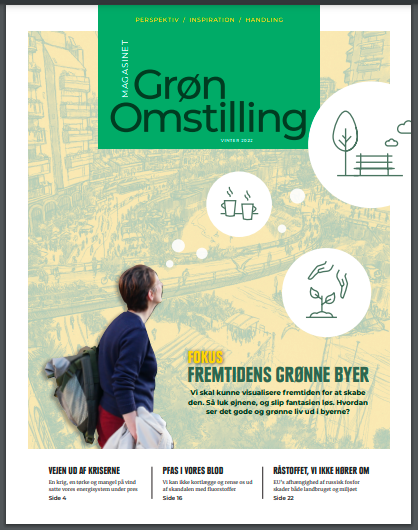
Three decades of great change

Black-and-white photos, articles translated from English and German, philosophical essays and, not least, a profound approach to climate and environmental crises as worldwide problems. The magazine Grøn Omstilling has been undergoing great change since it saw the light of day in April 1994. That was before the age of the Internet. The Ecological Council, as we were then called, wanted to convey stories from all over the world with the magazine Global Ecology - such as about the consequences of the Soviet-era plutonium plant, the environmental rights act in Canada, eco-fascism in Germany and the use of seal pups in the environmental struggle.

As we tracked our work to influence politicians and other decision-makers in Denmark and the EU to legislate with climate and the environment in mind, the magazine did the same and became more linked to the organization and its projects – in a design with stronger colors, images and illustrations and in interaction with web and social media.

The green thread through all generations is the irrepressible belief that we can create change if we act, inspire each other and understand the perspective. This approach is fundamental in the work of the Green Transition Denmark. We are concerned with finding green solutions that work and can make a difference to the benefit of society as a whole. We see ourselves as a green solutions think tank that will contribute to accelerating the transition to an absolutely sustainable society.

In recent years, we have spent more and more effort communicating via our website, rgo.dk, and via social media such as LinkedIn, Twitter and Facebook. And the experience is that we reach far more people on these virtual channels than via the printed magazine. We have over 18.000 followers on LinkedIn alone, and we share a lot of news, stories, position papers and notes via social media.

At the extraordinary general meeting on 18 September, a decision was therefore made to stop publishing Magasinet Grøn Omstilling, so that resources can be saved for printing and distribution. In return, we will use more effort and resources to modernize our website rgo.dk and disseminate new professional knowledge, in-depth analyzes and current stories about climate and the environment there.

Thanks for reading along. And we hope you will continue to help share our stories with your network and friends on social media.

By |2024-01-16T14:04:26+01:002. October 2023|News|0 Comments
Go to Top