The agricultural sector should be covered by the EU's quota trading system

These days, the EU Commission is working on a model for a CO2-quota system for the agricultural sector.

The EU Commission is considering three models for an emissions trading system (ETS) for this purpose. In this connection, the Green Transition Denmark has published a position paper, with a review of the models and recommendations.

It is the Green Transition Denmark's recommendation that a possible quota system for agriculture be placed at the farm level, as the largest and cheapest reduction potentials lie with the agricultural holdings themselves.

Read more in our English position paper.

By |2024-01-23T16:36:27+01:0019. October 2023|Position papers|0 Comments

Fuels should not be used in CO2 regulation

In connection with the revision of CO2 requirements for heavy vehicles in the EU, proposals have been made to also include fuels in connection with meeting the targets in the regulation. Read more about what's at stake and why we think it's a bad idea in our FAQ.

By |2024-01-16T15:57:28+01:0027. September 2023|News, Position papers|0 Comments

Electricity must be included in the transport

In Denmark, we have so far chosen not to equate electricity with biofuels and biogas in the displacement requirement, which is why the use of electricity in, for example, balers or trucks is not given a value.

You can read more about our recommendations in our position paper as well as in the translated note from our European organisations.

By |2024-01-16T14:12:48+01:0019. September 2023|Position papers|0 Comments

How we electrify the trucks quickly, easily and cheaply

Although trucks make up only two percent of the vehicles on the roads in the EU, they account for 27 percent of the climate impact from road transport. And with an expectation that trucking will increase by 40 percent towards 2050, it is important to quickly reorganize this sector.

Electrification offers the possibility of significantly lower climate impact as well as significantly lower air and noise pollution – especially in cities. Furthermore, Denmark has some of the best prerequisites for a rapid replacement for electric trucks. The terrain is flat and trucks that drive in Denmark generally don't drive that far. At the same time, compared to many other countries in Europe, we have a solid and well-functioning electricity grid.

Although all analyzes point to electric trucks becoming cheaper overall than diesel trucks, electric trucks are now so expensive as a starting point that a truck driver cannot get the finances together. For the same reason, our neighboring countries are investing massively in electric trucks. The Danish government has allocated a total of DKK 300 million. DKK for green conversion of heavy trucks in 2024-26. Although the amount of 300 million DKK is significantly less than what e.g. is set aside in Sweden, it can do a lot of good if the funds are used smartly.

In addition, it is important that the public charging infrastructure is in place as soon as possible. Therefore, it is also important that the EU has decided to establish charging infrastructure for electric trucks on the main grid in Europe. Funds have already been set aside for the establishment of charging infrastructure in the Infrastructure Agreement, just as there is a plan for how the AFIR requirements must be met in Denmark.

Several of these initiatives require greater societal investment. However, there are also a number of measures that can significantly contribute to the rapid electrification of trucks, but which are financially more affordable.

Main recommendations:

  • The proposed 300 million DKK in the Finance Act are combined into one pool for electric trucks that can be used in 2024, before road taxation comes into force.
  • The pool is supplemented with additional support for the purchase of electric trucks in 2025 and 2026.
  • A separate pool is established for electric trucks that drive less than 50.000 km per year and/or drive in the larger cities, regardless of size.
  • The pool is supplemented with support for storage charging in the period 2024-26.
  • The allocated 275 million DKK in the Infrastructure Agreement will be translated as soon as possible into fulfilling the EU legislation for the roll-out of public charging stations for electric trucks (AFIR) along the main road network in Denmark.
  • A guarantee for connection to the electricity grid of a maximum of 1 year should be introduced.
  • The largest municipalities should be allowed to implement zero emission zones from 2025.
  • A technology-neutral displacement requirement is introduced for heavy vehicles, where electricity is equated with biogas and biofuels in meeting the EU's renewable energy targets for transport from 2024.
  • The diesel tax should at least be raised to the level in Germany.
  • The toll for lorries is maintained and expanded to also include vans.

Find our entire position paper below.

By |2023-09-18T14:22:33+01:0018. September 2023|Position papers|0 Comments

Carbon farming – an important piece in agriculture's green transition

When plants are grown in agriculture, CO will be absorbed2 in the plants in the form of carbon. Part of this carbon is removed when the crops are harvested, but if roots, stumps or for example straw are allowed to remain in the field, or are plowed down, part of the carbon will be stored in the field soil. But carbon can also be stored in agricultural soil by adding biochar from pyrolysis, by growing forests as part of agriculture, or by doing reduced tillage.  

The Danish government is also focusing on initiatives that rely on carbon storage, both in the form of permanent CO2-storage in, for example, the North Sea and by investing in technologies such as pyrolysis, which will contribute to reductions of 2 million tonnes of CO2ei agriculture in 2030.  

In a proposal for a certification framework for carbon removal, the EU Commission has defined carbon farming as a carbon removal activity related to land management, which leads to increased carbon sequestration in living biomass, dead organic matter and in the soil by increasing carbon sequestration and/or reducing the release of carbon into the atmosphere . 

The way agricultural land is cultivated today means that carbon is removed from most fields, and therefore a CO2-discharge. When soil is cultivated, CO is also emitted2, as the carbon comes into contact with oxygen. It is assumed that soil on a global scale contains 2.500 billion tonnes carbon. In comparison, Denmark's total greenhouse gas emissions in 2022 were 44 million tonnes CO2-equivalents. However, since the 1870s we have globally lost between 50 and 70% of carbon from the top layer of the earth, and with rising temperatures, the loss is expected to increase. It is therefore important to ensure that we get forms of cultivation that can store carbon in the agricultural soil instead of removing it.  

Carbon storage in agricultural land cannot be compared to permanent storage, as a lot of biological processes take place in agriculture that affect the storage. It may make good sense to focus on agriculture's ability to build up carbon in agricultural land. But it is important that it is done in the right way.  

If carbon-storing forms of cultivation are used for a longer period, the soil will eventually reach a carbon equilibrium, and will therefore not have a net uptake of carbon. But the soil will continue to act as a carbon store. However, it is essential that carbon-storing forms of cultivation continue to be used, so that the carbon is not released back into the atmosphere if, for example, plowing or felling forests is done.


Carbon Removal Certification Framework (CRCF)

The EU Commission is working to develop a certification framework for carbon storage called Carbon Removal Certification Framework (CRCF), and came up with a proposal at the end of 2022 that includes both permanent storage of carbon in the underground, but also carbon farming in agriculture and storage in products such as wood in construction. It will therefore be a wide range of activities that can achieve a certification.


It may make good sense to standardize certification for the permanent storage of CO2, but it is problematic if non-permanent forms of storage such as carbon-storing cultivation and carbon storage in products are also included.

By |2024-01-16T14:14:49+01:0011. September 2023|Position papers|0 Comments

Recommendation to the Folketing: Stop mixing the harmful biofuels

In April 2023, the government proposed to increase the use of biofuels, including to reach Denmark's climate target for 2025. Green Transition Denmark recommends that the 2025 target be met with other means, as the mixing of biofuels has an uncertain and, at worst, counterproductive effect on global greenhouse gas emissions. If biofuels are maintained as a means of action, it is crucial that the most climate-damaging fuels are sorted out.

Specifically, the Green Transition Denmark recommends

  • Together with FDM and Drivkraft Danmark RGO recommends that the "calculation rules" for biofuels be updated so that all emissions count, including emissions from changes in land use (ILUC, Indirect Land Use Change). This will result in a technology-neutral market phase-out of the most climate-damaging biofuels.
  • If this is not possible, RGO recommends that biodiesel based on crops (including rape) be phased out directly by law, as these have the greatest climate impact.
  • In addition, RGO recommends that waste-based biofuels with limited raw materials (such as used frying oil and waste from animal production) be limited to levels corresponding to residual products collected in Denmark.

The vast majority of biofuels have a high climate impact

Biofuels made from crops that could have been used for food or animal feed are called 1st generation (1G) biofuels. In 2020, 87% of biofuels used in Denmark were 1st generation. They have a high climate impact because the raw materials used for biofuels cannot be used as food and feed at the same time, and therefore there is a need for new fields to grow food. When we in Denmark choose to grow rapeseed for biodiesel, there is ultimately a great risk that rainforests will be cleared to make way for new fields in South America or Southeast Asia. This is because it is especially in the tropics that new cultivation areas are included.

The result is that many of the biofuels grown on fields in Denmark and Europe have a very high indirect climate impact (the dark blue and orange columns in Figure 1). It is called "indirect land use change" or ILUC (indirect land use change). Often, the total climate impact from biodiesel in particular is even greater than for fossil diesel (the red line in Figure 1).

Figure 1 Direct and indirect climate effects of 1st generation biofuels. Source: Transport & Environment (2016): Globiom: the basis for biofuel policy post-2020

Implement the Danish Parliament's decision: Updating the biofuels' climate account

The Danish Parliament has already decided once that the most climate-damaging biofuels must be phased out, and that the "climate calculation rules" for biofuels must be updated, so that all emissions count, including ILUC emissions. Therefore, RGO, FDM and Drivkraft Danmark recommend that the parliamentary decision be followed up from 2020, as it will result in a market-based and technology-neutral phasing out of the most climate-damaging biofuels.

Should, contrary to the conclusions of a report commissioned by the Danish Energy Agency, it turns out not to be possible due to EU legislation in the area, the Green Transition Denmark recommends that a direct phase-out of crop-based biodiesel be introduced, as these biofuels have the greatest climate effect (see figure 1). This will be both in line with the agreement on the green transformation of road transport, which states that "it is crucial that first generation biofuels with high global emissions are phased out on an ongoing basis", as well as Article 26 of the Renewable Energy Directive.
There are also other solution models - Biogas Danmark has, for example, advocated for the distribution of 2G biofuels according to the German model.

Waste-based (2nd generation) biofuels are not unproblematic either.

Biofuels produced from waste are (unfortunately) not without indirect and problematic climate effects either. Eg. there is extensive fraud going on today where virgin palm oil (by far the greatest climate impact, see figure 1) is sold as used frying oil. In addition, biofuels from animal fat can lead to problematic substitution effects in the cosmetics and soap industry, where a lack of animal fat as a resource often leads to the use of palm oil. When that happens, the net effect of animal fat as a biofuel can be 1,7 times higher than that of conventional diesel.

Therefore, RGO recommends limiting the use of problematic 2nd generation biofuels, so that Denmark's consumption of used frying oil and residual products from animal production (dead animals and animal fat, etc.) is limited to levels corresponding to residual products collected in Denmark. In addition, a mapping of the various waste-based biofuel raw materials and their life cycle climate and environmental impact should be prepared, and on the basis of this, an assessment should be made as to whether further measures are necessary.

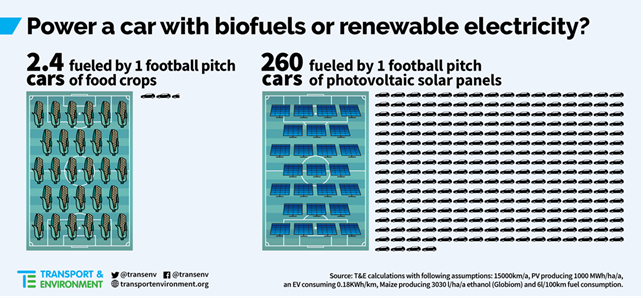
Figure 2 Biofuels are an inefficient tool for green conversion of road transport

Facts about Denmark's consumption of biofuels

In 2020, more than 380.000 m³ of biofuels were used, of which 87% were based on crop and feed raw materials. Rapeseed oil accounted for almost 50%. In a conservative estimate, the hidden climate footprint (ILUC emissions) from biofuels in 2021 was 350.000 tonnes of CO2, of which 300.000 tonnes of CO2 from canola alone.

In 2020, the consumption of biofuel seized 100.000 hectares of agricultural land, of which rapeseed accounted for 76.000 hectares. This corresponds to respectively just under 4% and 3% of Denmark's agricultural area, and for comparison, 100.000 hectares corresponds to 140.000 football pitches or 2 x Falster. On the area you could:

  • produce food to feed 2,5 million people
  • or carry out a full green transformation of the entire Danish transport sector (road transport, shipping and aviation) via solar cells, batteries and Power-to-X.

Find all sources in the PDF below.

By |2023-11-23T11:38:12+01:00June 1 2023|Position papers|0 Comments

A toxic environment calls for action now

There are more than 350.000 different chemicals in the environment today, and we have far from sufficient knowledge about the effects of all of them. It is demonstrated, that the level of chemicals in our environment has reached a level that is doing irreparable damage to the planet and requires urgent action. The EU Commission describes the pollution with chemicals as "a threat to human health" and "one of the most important driving forces that endangers the planet."

Nevertheless, the industry can use them unhindered in products ranging from toys to care products, furniture and textiles. It must be stopped, and here both the EU and Denmark must step in.

The EU Commission has set out an ambitious upgrade and strengthening of the EU chemicals legislation REACH via their 'Chemicals Strategy for Sustainability', presented in 2020. If the plan remains ambitious, it will mean that many more chemicals will be banned and phased out - not just individually , but also as entire substance groups. The purpose is to ensure a toxic-free environment for people and the environment, which must be done through the conversion to safe and sustainable chemicals and products.

But now the EU has chosen to postpone the revision of REACH. By delaying the process, people and the environment are kept in a situation where harmful chemicals continue to be emitted and can cause harm. It is not acceptable.

Therefore, the Council for the Green Transition calls for action:

1. Create a high level of protection for human health and the environment

The EU Commission should present the revised proposal for the REACH regulation before the summer of 2023. It must ensure the following:

  • The use of harmful chemicals is reduced so that we achieve a non-toxic environment;
  • The precautionary principle is used when an emerging risk must be dealt with quickly;
  • The legislation is updated so that it matches current research knowledge,
  • Group restrictions are used when whole groups of chemicals are of concern

2. Make the circular economy free of harmful chemicals

  • Harmful chemicals are banned in consumer products – with the greatest focus on products for particularly sensitive groups; children and pregnant/lactating women
  • Harmful chemicals must be kept out of recycling
  • Ensure safe limit values ​​for all product groups when recycling

3. Reduce consumption and resource pressure

  • Reduce the production and use of chemicals
  • Reduce single use and optimize multiple use – products that are repaired, upgraded or can be washed and refilled
  • Keep high-quality materials in circular loops so that resources retain their value and can be used for as long as possible

4. Introduce a national ban on PFAS

An EU ban on the entire chemical group PFAS is on the way, but may have very long prospects. It is the total exposure to PFAS that harms people and the environment. And any lowering of this level will have a positive effect. It is therefore of vital importance that the tap is closed as soon as possible.

  • A complete phasing out of the use of PFAS must be ensured as soon as possible
  • Set requirements for treatment plants regarding the purification of PFAS, so that the discharge to the aquatic environment is stopped
  • Pesticides must be included in the ban to ensure the highest possible protection and ease the burden on treatment plants. This also ensures a reasonable recycling of sludge.

Free from harmful chemicals

Harmful chemicals increase the risk of cancer and diabetes and can disrupt children's brain development and our hormone system. At the same time, it threatens the environment around us.  

Green Transition Denmark works to make our everyday life and environment completely free of harmful chemicals. read more on rgo.dk/kemikaliekrisen 

By |2024-01-16T15:56:53+01:0027. February 2023|News, Position papers|0 Comments
Go to Top