The Danish marine environment is under pressure
The sea, which stretches from the shore to the horizon, cannot swallow everything we throw out there without consequences. Report after report shows that the state of the sea is under pressure. And if we don't do something, it will ultimately cost us
Article published in Magasinet Grøn Omstilling, winter 2021 by Helene Chéret, Editor at Magasinet Grøn Omstilling
It was a sad sight that awaited the residents of Valsted by the Limfjord this summer. Dead fish, eels and crabs lay on the shore in heaps. The Danish Environmental Protection Agency had no doubt as to the cause: the animals had died from lack of oxygen, caused by oxygen depletion in the fjord. In July, measurements in Valsted north of the Nibe showed an oxygen percentage of just two.
Residents walking by the water were shocked. As the retired fisherman Gert Nielsen said TV2 Nord: “I have never seen anything close to this before in my life. Dogfish, crabs, flounder, eels, trout, shrimp, everything was fighting to survive," he said and continued: "I think we need to treat our fjords, our water and our environment so that we can be familiar with ourselves. Because the animals also have a right to be here.”
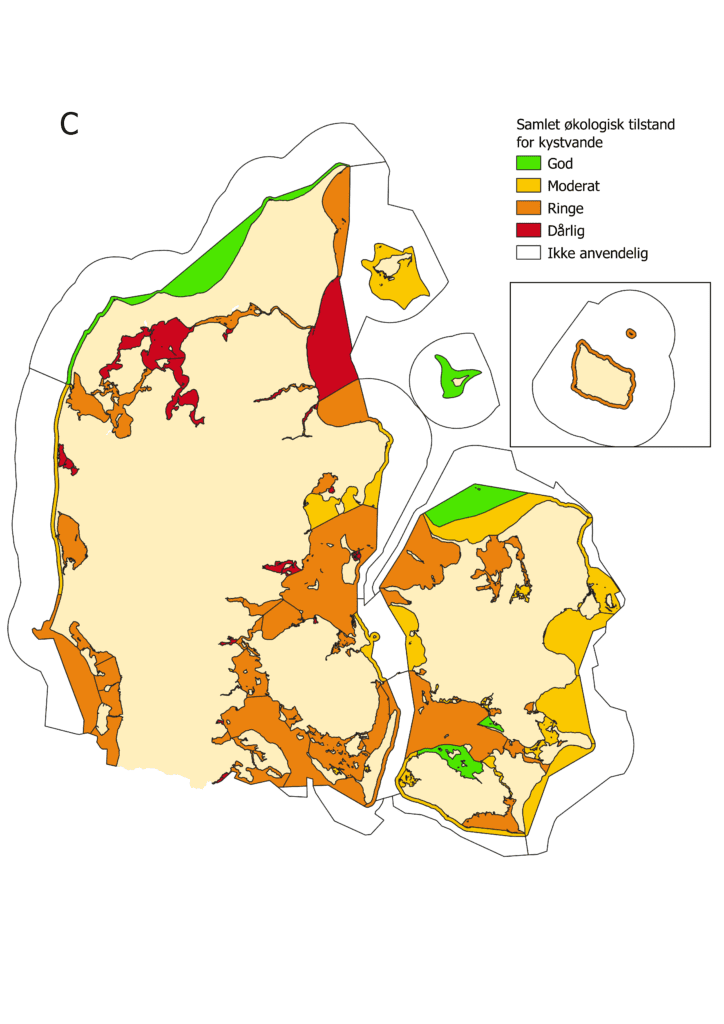
The situation in Valsted this summer is unfortunately only one of many signs that something is wrong with the state of the sea. When biologists go out to sea and to coasts to measure the levels of nutrients, harmful chemicals and microplastics or look at how animal and plant life and biodiversity are doing, it is worrying what they come up with. This is evidenced by, among other things, The Danish Environmental Protection Agency's monitoring of The board keeps an eye on the overall so-called ecological state of coastal waters and in the sea. The animal and plant life of the water areas and the level of environmentally hazardous chemical substances in the water are measured. According to the EU's water framework directive, Denmark must have improved water quality by 2027 so much that we have "good ecological condition" everywhere. But if you look at the Environmental Protection Agency's map with monitoring of the coastal waters, it looks bleak. Right now, only five percent of coastal waters live up to the goal of good ecological status and are thus colored green, while the 73 percent that have poor or poor status glow orange or red (see the map).
The reason for these sad measurements is usually our own behaviour, says Lone Mikkelsen. She is a biologist and senior adviser at the Green Transition Denmark.
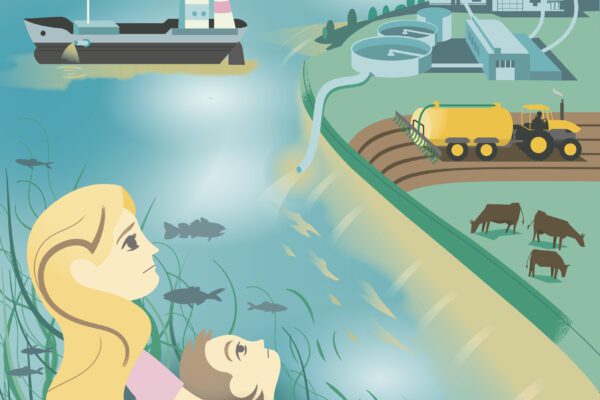
"The sea is in bad shape. Animals, plants and the entire ecological system are under pressure from many sides, all of which is due to what we humans discharge into the water or carry out activities at sea. The pressure is to a very large extent due to pollution from agriculture, discharge from waste water and shipping," she says.
Lone Mikkelsen, who coordinates the project 'A clean sea for all', believes that there should be an end to a widespread and possibly somewhat unconscious perception that the huge ocean just swallows everything without consequences.
"Out of sight, out of mind. We let all kinds of harmful substances seep into the sea. Out on the blue shelf, as fishermen and sailors used to say. But the sea cannot and must not be used as a bottomless dustbin. Everything we throw out there affects marine life. Still, report after report shows that the state of the sea is being allowed to sail its own lake," she says.
Seeps from the fields into the water
The oxygen depletion in Valsted this summer was one of the bad ones, but every year monitoring reports from DCE - National Center for Environment and Energy at Aarhus University show that the aquatic environment on many coasts and fjords suffers from oxygen depletion. The reason for this is mainly the discharge of nutrients from the fields. The nutrients feed algae, which shade the sea's other plants from light. They fall to the bottom when they die and decompose in a process where oxygen is consumed. And when there are many algae, all the oxygen can disappear. In the worst case, the animals die and wash up on the beach.
The EU has asked Denmark to curb our discharge of nutrients. But that has not happened, and that is critical, says Niklas Jørgensen. He is an agricultural advisor at the Green Transition Denmark and also works with the project 'A clean sea for all'.
"Just under two-thirds of Denmark's area is agricultural, and the way we farm threatens the underwater ecosystems. We have been required by the EU to significantly improve the water environment, but this has not yet happened. A further reduction in the discharge of nutrients from agriculture is simply necessary," he says.
Part of the explanation is connected to the controversial agricultural package from 2015, which the then government made. Here it was decided that agriculture had to fertilize more than before in order to increase its production. And it has backfired.
"The idea was that with other measures, such as compensatory follow-on crops and the establishment of wetlands, you could nevertheless reduce the release of nutrients. But it did not happen. The latest reports show that emissions have been fairly stable over the past ten years. It goes beyond our water environment," says Niklas Jørgensen.
When the government and the parties to the agreement drew up a broad climate agreement for agriculture in the autumn, they also presented a plan to reduce nitrogen emissions, as required by the EU. But according to Niklas Jørgensen, it has several shortcomings. The effort to reduce nitrogen pollution by 13.100 tonnes will not reach the target by 2027, as 2.300 tonnes of these will only be found at a later revisit of the agreement, which is otherwise initiated too late.
"The agreement also does not relate to the fact that we have to get better at reducing the supply of fertiliser, for example by fertilizing less in particularly vulnerable areas and distributing livestock manure better between the parts of the country," says Niklas Jørgensen.
The cod can disappear completely
In the autumn, the EU significantly cut the cod quotas, much to the chagrin of the fishing industry. The cod population in Danish waters has declined, and the researchers warn that the cod could disappear completely if nothing is done. Cod has been a common fish species in Denmark and Northern Europe for many years. But in the Baltic Sea, for example, there has been a decline in herring and cod stocks of 80 and 85 percent respectively over the past 30-40 years. There are several explanations for the decline in fish populations: pollution, oxygen depletion, climate change, overfishing and destroyed habitats such as rocky reefs and kelp forests that have disappeared, among other things. due to stone fishing, sand extraction and other raw material extraction.
According to Lone Mikkelsen, the decline in fish stocks is a clear example of our behavior ultimately affecting ourselves.
"Fish stocks are shrinking, and biodiversity in general is declining in the seas around Denmark. This happens, among other things, because we contaminate the water from land with nutrients and harmful chemicals, and this is critical for the organisms that live in the sea. It affects the ecosystem directly and, in addition, harmful substances accumulate in the fish and shellfish that many people depend on as a food source. The figures from the Danish monitoring of the aquatic environment clearly show this. So in the end, the problem affects not only the environment, but also ourselves," says Lone Mikkelsen.
Pollution with harmful chemicals is one of the areas that is far from sufficiently studied. Denmark has repeatedly received strong criticism from the EU Commission for not measuring enough the so-called chemical state of the sea. But the measurements that are carried out after all show that many harmful substances are discharged into the sea. The latest report from the national monitoring program NOVANA finds many exceedances of limit values for e.g. pesticides, heavy metals and flame retardants, many of which are already either banned or regulated. This applies, for example, to dioxins from burning plastics and PCBs from e.g. building materials. These two are among the most dangerous environmental toxins in the world and are now completely banned from use. Nevertheless, they and many other harmful and difficult-to-degrade chemicals are found in the aquatic environment. Some of the chemicals end up in the fat tissue of fish, others lie accumulated in the sediment, but are stirred up if the bottom is scraped up, e.g. of a trawl. And hormone-disrupting substances from e.g. medicine, care products and electronics also end up in the aquatic environment. According to Lone Mikkelsen, the key to part of the solution lies with the sewage treatment plants.
"The waste water plants here at home do not catch the harmful substances, such as flame retardants and fluorine substances. In Switzerland, many treatment plants use a method that can remove chemicals from the waste water. So the technology exists. It's just not acted upon from the political side here at home. But it is absolutely crucial that such a type of cleaning is required in Denmark as well. This will contribute to far fewer harmful chemicals being emitted from cities, industry and hospitals. We have absolutely no control over how much ends up in the sea," she says.
Rift about the sea
Today, more and more stakeholders have their eyes on the sea and see great opportunities. In this connection, the government has drawn up Denmark's first marine plan, which was consulted on in the autumn. It must "lay out a plan for the total Danish sea area. The marine plan must both strengthen the green transition, protect nature and ensure that there is still room for the maritime industries" as stated in the introduction. The plan divides the sea into zones according to activities, use and future potential. There are thus zones for, for example, wind farms, breeding of fish in open cages (sea farming), extraction of raw materials, the military and protected or protected areas.
But even though protection of nature is described as part of the plan, Lone Mikkelsen does not believe that the environment is being catered for to a sufficiently high degree.
"The focus is primarily on the needs of businesses and not on those of nature. It is really good that you are trying to plan and protect more of the sea. But at the same time, trawling is still allowed in some protected areas, which will lead to a release of the chemicals that were otherwise settled in the sediment. And aquaculture emits, in addition to more nutrients, biocides into the water, which are in turn taken up in the food chain," she says.
When you look across the water, it is also clear that the sea is becoming more and more crowded - with more wind turbines, port extensions, commercial fishermen and large cargo and cruise ships. And that worries Lone Mikkelsen.
"In the future, we would like to harvest even more from the sea, e.g. seaweed as protein-rich food. We will have to be careful that, in our zeal for development and change, we do not continue to destroy the possibility of elementary life in the water. Otherwise, it will die quietly," she says and continues:
"What happened at the Limfjorden this summer was sad. And I completely agree with the resident of Valsted; we must treat our fjords, our water and our environment so that we can be familiar with ourselves. Therefore, we must have curbed the emissions of nutrients and harmful chemicals as soon as possible. We must improve the condition of the sea - for nature's sake, but also for our own sake," she says.
For further information:

Read more about the project:
READ MORE